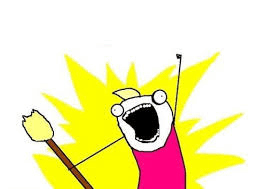
ALL THE THINGS
Life tends to pile up in unexpected ways, and “all the things” can sometimes feel like too many plates spinning at once. There are the tasks you know about, the ones you’ve forgotten, and the ones you didn’t ask for but now have to handle anyway. It’s the quiet emails waiting in the inbox alongside the loud notifications demanding attention. It’s that half-finished coffee sitting on the desk next to three different lists. Together, they paint a picture of everything happening at once, but also of how much you’ve already managed to carry.
The phrase works as a kind of shorthand, an umbrella term that covers the impossible variety of life. “All the things” doesn’t just mean chores or errands — it stretches to include conversations, ideas, deadlines, and even stray thoughts. It’s useful because it saves time, bundling chaos into two small words. The trade-off, of course, is that the details disappear, leaving you with a sense of weight rather than a clear plan. Still, there’s something oddly comforting about the phrase, like a friend who shrugs and says, “same here.”
Testing a layout with these words reminds you that design has to bend around real human messiness. You can’t expect every page to look neat when the content is unpredictable. Sometimes “all the things” might mean two lines of text, other times it’s three paragraphs spilling onto the next page. Good design has to hold both extremes gracefully. That’s why developers and designers fill their mockups with phrases like this: not because they’re accurate, but because they mimic the untidy way people really use websites.
There’s also a rhythm to the phrase that makes it flexible in writing. It works in serious essays, casual conversations, or playful experiments. Writers use it to soften the edge of overwhelming detail, giving readers a way to nod along without needing the fine print. In design, it becomes a stress test, checking whether buttons, headings, and margins can adapt when text grows or shrinks. “All the things” can break layouts — which is exactly what makes it useful for testing them.
Beyond design, the phrase resonates because it captures a universal truth: everyone is dealing with more than they can comfortably describe. Your “all the things” might not match mine, but we both understand the feeling. It can mean projects at work, errands at home, emotional baggage, or simple exhaustion. No matter the specifics, the phrase compresses a thousand little details into something that feels relatable. That’s why it sticks, and why it’s easy to smile at it even when you’re overwhelmed.
In the end, “all the things” is a placeholder, a catch-all, and a mirror. It’s deliberately vague, yet somehow precise enough to carry meaning. For layout testing, it stretches content areas in ways that show you whether your site is robust. For daily life, it admits that everything is too much sometimes, but that you’re still here handling it anyway. And maybe that’s the secret power of the phrase: it doesn’t try to fix the chaos, it simply acknowledges it, and in doing so, makes it easier to keep going.